
The Deterministic AI Illusion: Why Most Claims Don't Hold Up Under the Hood
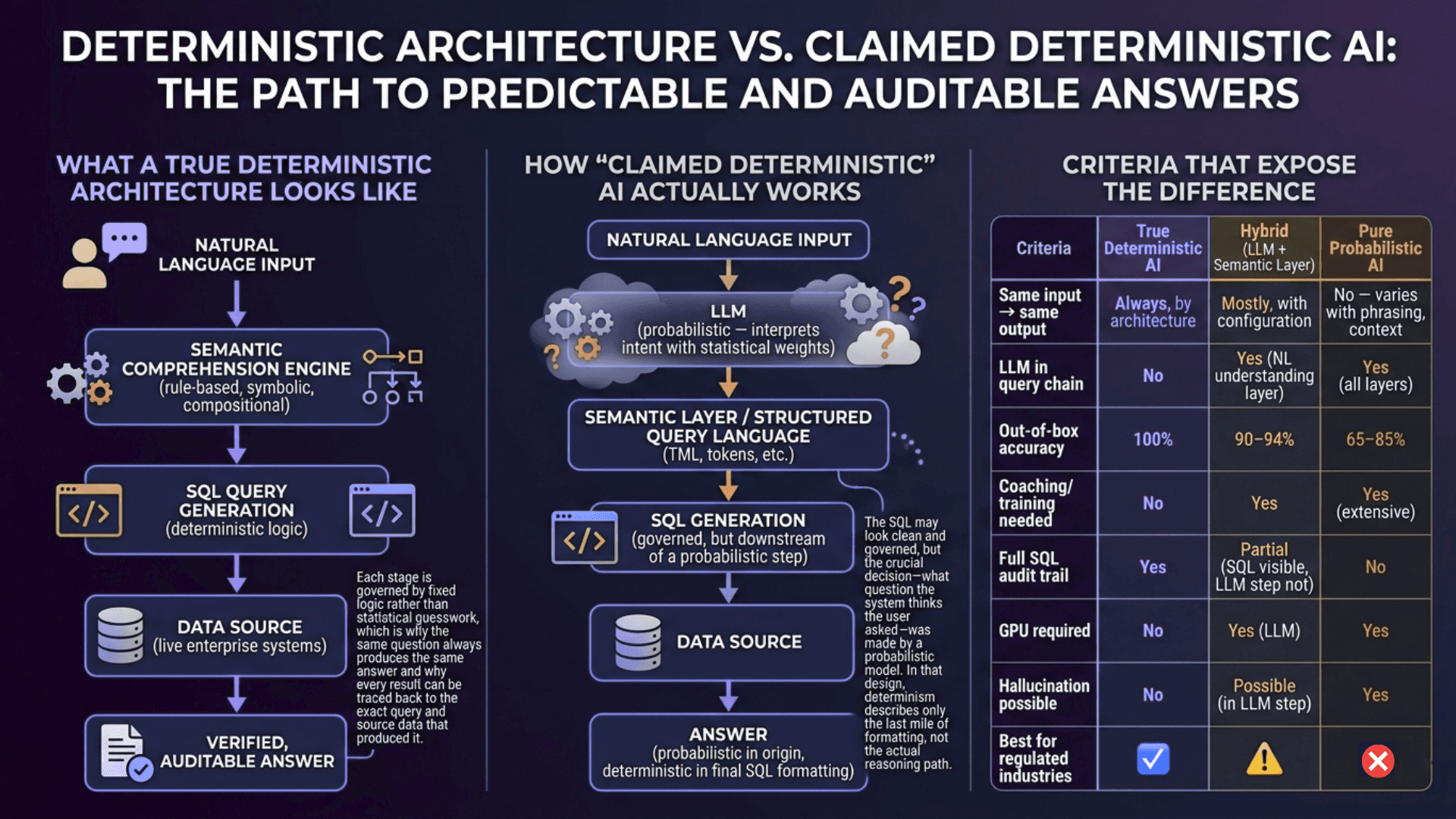
Many enterprise software vendors are now claiming some form of “deterministic AI.” But in many cases, that label describes the guardrails around the system, NOT the system itself. If a probabilistic model is still interpreting intent, deciding what logic to run, or generating the query path, then the platform is not deterministic by architecture, even if the output is later wrapped in governance controls (which in themselves may not be deterministic!).
That distinction matters more than most buyers realize. In enterprise settings, “mostly right” is not the same thing as repeatable, auditable, and trustworthy. A model that guesses well can still fail in exactly the places businesses care most about: finance, compliance, operations, and regulated decision-making.
Two Architectures, Two Risk Profiles
Probabilistic AI and deterministic AI solve different problems. Large language models are excellent at language generation, summarization, brainstorming, and pattern-matching, but they operate by predicting the most likely next output from statistical patterns. That makes them useful in creative and exploratory tasks, but inherently variable in high-stakes execution paths.
A truly deterministic system works differently. The same input should produce the same output every time, and every answer should be traceable to the exact logic and data source that produced it. In analytics, operations, and enterprise execution, that means the system can show the actual query, the actual result, and the actual source data without asking a model to guess what the answer probably should be.
What True Determinism Looks Like, And Why It's Rare
In a deterministic system, the entire path from question to answer is explicit and repeatable:
Natural Language Input
↓
Semantic Comprehension Engine (algorithm-based, symbolic, compositional)
↓
SQL Query Generation (deterministic logic)
↓
Data Source (live enterprise systems)
↓
Verified, Auditable Answer
Each stage is governed by fixed logic rather than statistical guesswork, which is why the same question always produces the same answer and why every result can be traced back to the exact query and source data that produced it.
How “Claimed Deterministic” AI Actually Works
By contrast, many platforms that market themselves as deterministic still place a probabilistic model at the start of the chain:
Natural Language Input
↓
LLM (probabilistic - interprets intent with statistical weights)
↓
Semantic Layer / Structured Query Language (TML, tokens, etc.)
↓
SQL Generation (governed, but downstream of a probabilistic step)
↓
Data Source
↓
Answer (probabilistic in origin, deterministic in final SQL formatting)
The SQL may look clean and governed, but the crucial decision—what question the system thinks the user asked—was made by a probabilistic model. In that design, determinism describes only the last mile of formatting, not the actual reasoning path.
Criteria that Expose the Difference
The architecture gap becomes clearer when the key criteria are compared side by side:
Criteria | True Deterministic AI | Hybrid (LLM + Semantic Layer) | Pure Probabilistic AI |
Same input → same output | Always, by architecture | Mostly, with configuration | No - varies with phrasing, context |
LLM in query chain | No | Yes (NL understanding layer) | Yes (all layers) |
Out-of-box accuracy | 100% | 90–94% | 65–85% |
Coaching/training needed | No | Yes | Yes (extensive) |
Full SQL audit trail | Yes | Partial (SQL visible, LLM step not) | No |
GPU required | No | Yes (LLM) | Yes |
Hallucination possible | No | Possible (in LLM step) | Yes |
Costs | Low | High | High |
Business Impact | Low infra cost, high margins, audit-ready OOB, no retraining overhead | High GPU cost, ongoing tuning, costs rise with usage | High hallucination liability, not fit for regulated enterprise |
Best for regulated industries | ✅ | ⚠️ | ❌ |
This is why buyers should be careful with the phrase “deterministic AI.” A hybrid system may be governed and useful, but if an LLM still sits in the interpretation layer, the architecture is not truly deterministic end to end.
How Pseudo-Deterministic AI Appears
Many modern platforms do not claim raw LLM output is trustworthy on its own. Instead, they build semantic layers, confidence thresholds, routing controls, or human-review loops around a probabilistic model. Those controls may reduce risk, but they do not remove the probabilistic step from the system. They manage the guess; they do not eliminate it.
For buyers, four tests expose the difference quickly:
The API call test. If the platform must call an external LLM to understand user intent before it can determine what query or workflow to run, then probability is already in the pipeline.
The confidence-score confession. If the platform talks about confidence scoring, fallback routing, or human-in-the-loop review, it is acknowledging uncertainty in the model output.
The coaching red flag. If the vendor says the product works “out of the box” but becomes accurate only after coaching or training, then accuracy is being improved through correction, not guaranteed by architecture.
The infrastructure signal. Heavy GPU dependency is often a practical sign that the system still relies on LLM inference rather than direct, deterministic execution on structured enterprise data.
The hidden cost of "pseudo-deterministic AI" is often overlooked. Layering more probabilistic AI on top of itself to manage its own uncertainty demands significantly more GPU processing power, drives up costs far beyond what true deterministic AI requires. Neuro-Symbolic AI, such as Quarrio's CoDEM, avoids this trap by combining the fluency of large language models with the precision of logic-based reasoning, for accurate, verifiable outputs without the computational overhead. (To learn more, read: The Architecture of Absolute Truth: Symbolic and Neuro-Symbolic AI Create the Foundation of Trustworthy Enterprise Intelligence.)
A Simpler Market Map of 3 Categories
The market is easier to understand when viewed through three buckets.
1. Guardrail pseudo-determinism
These vendors place governance, semantic modeling, or strict rules around a probabilistic core. The system may feel controlled, but an LLM is still interpreting intent or generating logic under the hood.
Company X is a useful example. Its messaging emphasizes trust, semantics, and governed analytics, yet the broader workflow still depends on external LLMs for natural-language understanding. Company X’s own materials also acknowledge that coaching improves accuracy, which is precisely the kind of signal enterprise buyers should treat as evidence of probabilistic architecture rather than native determinism.
2. Hybrid deterministic grounding
Some vendors are more architecturally honest. They use deterministic components for grounding, orchestration, or causal analysis, then layer probabilistic reasoning or natural-language interaction on top. These are not fake systems; they are hybrids.
Company D is a good example of that middle category. Its deterministic grounding layer in observability has real substance, but its broader agentic and explanatory experience still includes probabilistic AI. That makes it a thoughtful hybrid-not the same thing as end-to-end deterministic execution.
3. True architectural determinism
This category is the rare one. Here, the core system that turns business language into execution does not rely on statistical inference in the reasoning chain. The logic path is fixed, repeatable, and verifiable.
That is the distinction that matters. If the question is translated directly into a verified database query without an LLM deciding what the system “probably meant,” the result is not merely governed-it is deterministic by design.
Why This Matters to Enterprise Buyers
This is not just a technical debate. It affects cost, risk, auditability, and time to trust. A platform that depends on coaching, model tuning, or confidence thresholds may eventually become useful, but it still introduces uncertainty into systems that many enterprises expect to behave with precision. For leaders in finance, healthcare, manufacturing, and operations, the bar is higher. They need systems that can explain exactly what happened, reproduce the same outcome, and withstand scrutiny from auditors, operators, and compliance teams. “The model was usually right” is not the standard those environments are built around.
Five Questions That Separate Real from Repackaged
Before accepting any claim of “deterministic AI,” enterprise teams should ask:
If we ask the same question 1,000 times, will we get the same answer every time - guaranteed by architecture?
Does your system call an LLM to interpret the user’s intent before generating a query or action?
What is your out-of-box accuracy rate without coaching, training, or human correction?
Can you show the exact executable query or logic path behind every answer?
What is your GPU dependency, and where in the workflow is it required?
Determinism should describe the core execution path, not the governance layer wrapped around it. (Quarrio can help non-deterministic systems behave more deterministically – see: Making GenAI Trustworthy: A Deterministic System of Record for AI Interactions.)
The real test of deterministic or not, is simple: Does the system interpret business language and execute against enterprise data without introducing statistical guesswork into the logic chain?
That matters because native determinism changes the tradeoff profile. It reduces hallucination risk, improves auditability, lowers infrastructure requirements, and shortens the path from user question to trusted answer. It also gives enterprise buyers something they rarely get in AI: architectural clarity.
Accuracy is not a configuration setting, it is a strategic commitment. Companies building on that foundation are the ones that scale without accumulating technical debt, retraining costs, or hallucination liability.
Learn more at quarrio.com.

100% Accuracy, Full Auditability, Real ROI
Copyright @2015 - 2026 Quarrio. All rights reserved.