
Why 90% of Enterprises Can't Scale Agentic AI and How Deterministic AI Closes the Gap
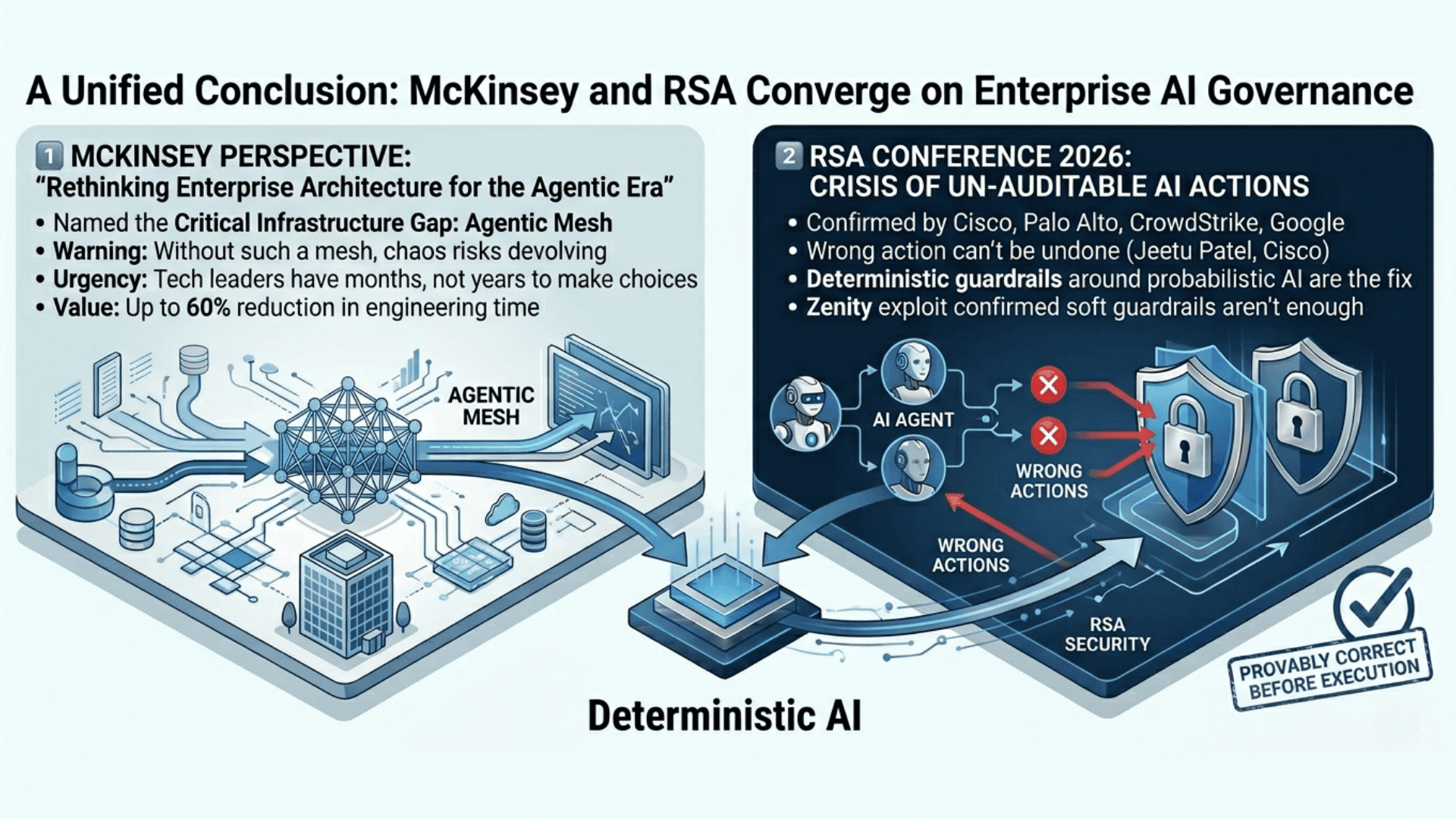
McKinsey and RSAC 2026 reached the same conclusion independently - confirming what Quarrio's architecture was built for all along
In their March 2026 piece, “Rethinking Enterprise Architecture for the Agentic Era,” McKinsey identified the single most critical missing layer in enterprise AI: the agentic mesh: a governance, coordination, and truth layer that connects AI agents to each other, to legacy systems, and to a shared source of verified data.
At RSAC 2026, Palo Alto, Cisco, CrowdStrike, and Google all announced tooling for the same underlying crisis: AI agents operating inside enterprise systems with broad credentials, machine-speed decision-making, and no audit trail.
What McKinsey and RSAC both identified - independently - is a structural gap, not a tool gap. The challenge isn’t detecting bad agent behavior after the fact. It’s building systems where every agent action is provably correct before it touches a transaction, a compliance record, or a capital allocation. In mission-critical environments, “likely correct” is not an acceptable architecture.
A Compelling Vision With a Critical Gap
McKinsey describes the agentic AI mesh as “the connective tissue of the enterprise”, a composable architecture that enables AI agents to reason, collaborate, and act autonomously across systems. Their research identifies it as “the foundation of the next-generation operating model,” with early adopters already seeing productivity at least double in targeted deployments.
The vision is compelling: networks of specialized agents working in concert across your CRM, ERP, financial systems, and supply chain without a human clicking a button. But McKinsey’s own 2026 AI Trust Maturity Survey reveals the problem hiding inside that vision.
The Readiness Gap, by the Numbers
The data is consistent across multiple sources:
Parseur Survey, January 2026: 61% of organizations say they are not ready for agentic AI, even as deployment accelerates
Cisco, RSAC 2026: 85% of enterprise customers have AI agent pilots underway. Only 5% have moved agents into production
Deloitte State of AI in the Enterprise 2026: Only 21% of organizations have a mature governance model for autonomous AI agents, meaning 79% are deploying agents without the infrastructure to manage them safely
Adoption is racing ahead of accountability. Probabilistic AI cannot be governed the way enterprise operations require.
What "Probably Right" Actually Means
Probabilistic AI gives you different answers to the same question and cannot explain why. When AI was advisory, a human caught the errors. When AI is operational, that uncertainty becomes a compliance violation, a financial loss, or a regulatory action with no audit trail. "Probably right" is acceptable when drafting a document. It is not acceptable when running a business.
Governed Autonomy Requires Three Things
Of McKinsey's five agentic mesh principles: composability, distributed intelligence, layered decoupling, vendor neutrality, and governed autonomy - governed autonomy is the one that breaks down in most deployments.
For an AI action to be genuinely governed, it must be:
Auditable. Reconstruct exactly what question was asked, what data was used, what logic was applied, and what output was produced.
Repeatable. The same inputs, the same data, the same output. Every time. If the answer changes on a Tuesday, you cannot build a business process on top of it.
Verifiable. Business rules and policy boundaries enforced at the data and logic layer, not just at the interface where a human might catch them.
Probabilistic AI satisfies none of these reliably. So where does the deterministic layer live?
The Mesh Needs a Foundation
McKinsey describes the mesh as "the connective and orchestration layer that enables large-scale, intelligent agent ecosystems to operate safely and efficiently." But in most deployments, there is no shared source of truth. Each agent manages its own context, interprets rules against its training, and reconstructs facts from patterns, generating answers that vary by agent, by moment, and by inference. The mesh becomes a network of independent best guesses with no common ground beneath them
What It Looks Like When It Works
Take a financial services firm monitoring risk across trading desks; a scenario McKinsey cites as a prime agentic AI use case. In a probabilistic architecture, agents infer rules they weren't given and leave no audit trail.
When a regulator asks why a flag was raised, the answer may not exist. In a deterministic architecture, every action is logged: exact query, exact data, exact output, reproducible on demand. The regulator asks. The answer is a record. Every other system of record in your stack already meets that standard. Your business cannot operate successfully if you let AI be the exception.
Quarrio: The Deterministic Foundation the Agentic Mesh Needs
Quarrio is the only deterministic semantic AI platform for enterprise execution - the foundational layer that makes McKinsey's agentic mesh vision governable at scale.
Quarrio's deterministic agents retrieve verified data directly from your CRM, ERP, financial data feeds, and supply chain platforms. No guessing. No hallucinating. If the data exists, Quarrio returns it with full provenance. If it doesn't, Quarrio says so. Every answer includes the underlying SQL code. Ask the same question a hundred times. Get the identical answer every time.
But accountability doesn't stop at the data layer. Quarrio's semantic architecture means a CFO, a compliance officer, or a supply chain analyst can ask questions in plain language and receive a verifiable, auditable answer, without requiring SQL, or coding skills. The determinism covers both the data and the language. The integrity runs end to end.
This is by design, because at Quarrio, stewardship is the operating principle behind every architectural decision. We are responsible for the time, money, data, and trust that enterprises place in us - which is exactly why we built deterministic AI: not because it was easier, but because it was right.
McKinsey is right that the agentic mesh is the architecture of the intelligent enterprise. But the mesh requires a deterministic core to deliver on its governance promise – a core that only Quarrio provides.
To see Quarrio in action - book a 15-minute demo.
Related reading:
Deterministic vs Probabilistic AI: What Business Leaders Need to Know
McKinsey: Rethinking Enterprise Architecture for the Agentic Era
McKinsey: State of AI Trust in 2026 - Shifting to the Agentic Era

100% Accuracy, Full Auditability, Real ROI
Copyright @2015 - 2026 Quarrio. All rights reserved.